
Sobha Sacred Grove by the Lake Master Plan - 26-Acre Gated Plotted Layout
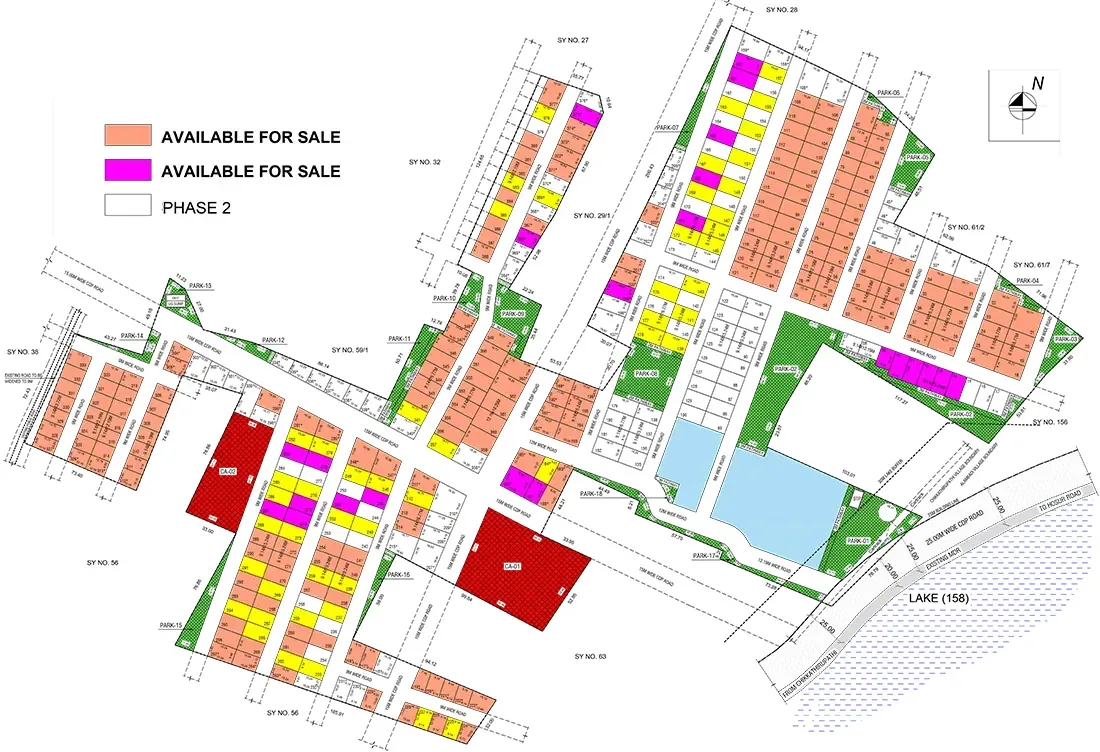
The Sobha Sacred Grove by the Lake master plan organises roughly 26 acres at Chikkatirupathi into a low-density, gated community of 388 plots. Wider streets and setbacks, more green per resident, and a quieter, more private environment than a packed layout - these are deliberate planning choices that protect both daily livability and long-term value. For another Bengaluru planning reference, Splendid Evora helps keep attention on density, circulation, landscape depth, and the way residents will move through the community.
The 388 plots are arranged along a hierarchy of 12-metre and 9-metre tree-lined streets engineered for low-density living. Below the surface sits the real Sobha differentiator: a fully planned utility grid - twin water pipelines, underground electrical reticulation, a sewage network feeding a central STP, and a high-capacity stormwater system - so that the moment you take possession, your plot is genuinely build-ready.
Sobha Sacred Grove by the Lake Land-Use Breakdown
| Land-use component | Allocation / treatment |
|---|---|
| Saleable plots | 388 plots, 1,200 - 2,750 sq.ft |
| Open / green space | ~45% of the site |
| Miyawaki forest | 10,000+ native trees |
| Amenity core | Clubhouse, swimming pool, sports academy |
| Internal roads | 12 m and 9 m, tree-lined |
| Utility infrastructure | Central STP, OHT/sumps, stormwater, electrical reticulation |
Where Sobha's Engineering Matters Most: Below-Ground Infrastructure
Water reaches each plot boundary through a twin-pipeline system - one line for potable supply, a separate line carrying recycled water for landscaping - backed by overhead tanks, sumps and rainwater-harvesting pits distributed across the site. All electrical cabling is laid deep underground for safety and a clean streetscape, fed from the BESCOM grid, with an individual power point at each plot and LED lighting along the streets.
An underground sewage network connects to a central sewage treatment plant; treated water is reused to irrigate the 26 acres of parks and greens, closing the water loop. High-capacity concrete storm drains on both sides of every road manage monsoon runoff. Because all of this is in place before handover, a buyer can begin construction immediately - without first laying private utilities, the hidden cost and delay that defines raw-land purchases.
Reading the Master Plan: How It Translates to Value
Generous open space and the Miyawaki forest make the community a desirable place to build and live, which sustains end-user demand. Fully engineered underground infrastructure means build-ready plots and no hidden servicing costs. The amenity core - clubhouse, pool, sports academy - gives a plotted community the lifestyle pull of an apartment complex while preserving land ownership. And the low-density, gated design with a single secured entry protects the long-term character of the layout.
When you review the master plan on a site visit, focus on the position of your plot relative to the amenity core, the forest and the entry; the road hierarchy serving your plot; corner and three-side-open opportunities; and the green outlook. Plots facing the Miyawaki forest, parks or lakeside greens are the most desirable in the layout.
Due-Diligence References
Cross-check with plot options and amenities on this site, then use the links below for independent verification.
Sobha Sacred Grove by the Lake Green Belt and Open-Space Design
The defining green feature of Sobha Sacred Grove by the Lake is the Miyawaki forest - a dense planting of 10,000+ native species using the Miyawaki method, which grows a self-sustaining, multi-layered woodland far faster than conventional landscaping. Beyond its visual and ecological value, the forest moderates the microclimate, improves air quality, supports biodiversity and gives the community its "Sacred Grove by the Lake" identity. Around it, landscaped greens, lakeside open spaces, parks and tree-lined avenues distribute the ~45% open space across the site so that green is never far from any plot. Senior-citizen sit-outs, children's play areas and a party lawn are woven into these greens, turning open space into usable community space.
The layout is designed to be walkable as well as drivable. Footpaths run alongside the internal roads, and dedicated walking and jogging tracks thread through the forest and greens, so Sobha Sacred Grove by the Lake residents can move on foot to the clubhouse, sports academy and parks without sharing the carriageway. Landscaping follows the forest-to-home theme: native, low-water planting along streets and in the open spaces, lakeside greens, and shaded sit-out zones. The intent is a community where the public realm - not just the private plot - is a place residents actively use.
Sobha Sacred Grove by the Lake Plot Placement Strategy
Plots at Sobha Sacred Grove by the Lake are arranged along a hierarchy of streets to balance privacy, frontage value and easy circulation. The eight plot sizes are distributed so that compact 30x40 and 30x45 plots, larger 30x60 and 40x60 plots, and estate-scale 50x55 plots are each available across the layout, giving buyers a choice of position relative to the amenity core, the forest and the entry. Corner and three-side-open plots - which carry a natural premium for light, ventilation and design freedom - are positioned at junctions in the street network. Because the layout is low-density, even interior plots enjoy generous setbacks and a green outlook rather than the back-to-back crowding common in unbranded layouts.
The road hierarchy is structured for a calm, residential experience: wider primary spines feed narrower residential streets, keeping through-traffic away from quieter plot clusters while ensuring every plot has clean vehicular access. Avenue planting along the roads provides shade and reinforces the forest-to-home theme. A single gated entry controls access, channelling all vehicles and visitors through a secured, monitored point. The combined effect is that of an organised, premium residential campus - the visual texture buyers expect from a Sobha development - rather than a transactional plot grid.
Sobha Sacred Grove by the Lake Sustainability and Future-Proofed Infrastructure
The Sobha Sacred Grove by the Lake master plan treats sustainability as infrastructure rather than decoration. The central STP and twin-pipe recycling minimise fresh-water draw and keep the landscape green on treated water. Rainwater-harvesting pits recharge groundwater across the site. The 10,000-tree Miyawaki forest and ~45% open space sequester carbon, cool the microclimate and manage runoff naturally. Underground reticulation and LED street lighting cut energy use and visual clutter. Together these systems are designed to keep Sobha Sacred Grove by the Lake green and water-secure as it matures into a fully occupied community.
A well-designed plotted master plan anticipates the community at full occupancy, not just at handover. The utility networks here - water, sewage, stormwater and power - are sized for the demand of fully built-out plots with occupied homes, so that the infrastructure does not become a bottleneck as the community matures. The central STP is dimensioned for the full resident load; the stormwater system is built for monsoon peaks; the electrical reticulation carries headroom for household demand. This forward sizing is a hallmark of engineering-led development and a frequent failure point in unbranded layouts, where infrastructure is laid to minimum and quickly overwhelmed. For a buyer at Sobha Sacred Grove by the Lake building a long-term home, this future-proofing means the community will function well not just on the day they move in, but decades later.
A 26-acre, 388-plot layout is developed in a sequenced manner - infrastructure first, then handover. In practice this means the internal road network, the water and power reticulation, the sewage and stormwater systems, and the boundary wall and gated entry are established as the primary works, followed by the amenity core (clubhouse, pool, sports academy) and the landscaping and forest planting. Plots are handed over build-ready once the servicing in their cluster is complete. RERA registration binds the developer to disclose this progress quarterly, so buyers can track the build-out at Sobha Sacred Grove by the Lake against the filed schedule rather than relying on marketing assurances.
It covers a registered plotted scheme in Mysuru, and layout decisions that read as brand habit in one project are easier to identify when a second one is in view.
Sobha Sacred Grove by the Lake Master Plan FAQs
How big is the Sobha Sacred Grove by the Lake layout?
Roughly 26 acres with 388 villa plots, and approximately 45% of the site dedicated to open and green space, including a 10,000-tree Miyawaki forest.
How wide are the internal roads?
Internal circulation is built on 12-metre and 9-metre tree-lined streets, with concrete drains on both sides to prevent water-logging, and a single gated entry controlling all access.
What infrastructure runs below ground?
A twin-pipeline water system, underground BESCOM electrical reticulation, an underground sewage network to a central STP, and high-capacity stormwater drains - all in place before handover so plots are build-ready.
How much of the site is open space?
Roughly 45% of the 26 acres is open and green space, anchored by the 10,000-tree Miyawaki forest, with landscaped greens, lakeside open spaces, parks and tree-lined avenues distributed across the layout.
Is the layout low-density?
Yes. At 388 plots across 26 acres with ~45% open space, Sobha Sacred Grove by the Lake is deliberately low-density - wider streets and setbacks, more green per resident, and a quieter, more private environment that protects long-term value.
How is the project developed in sequence?
Infrastructure first, then handover: the road network, water and power reticulation, sewage and stormwater systems and gated entry are established as primary works, followed by the amenity core and landscaping. Plots are handed over build-ready once their cluster's servicing is complete.